

On Page SEO Checklist UK: 25+ Essential Steps to Boost Rankings in 2026
If you want better rankings in 2026, here’s the thing.
On page SEO is no longer about adding a few keywords, writing a title tag and hoping Google rewards the page.
Search has changed.
Google now looks at intent, usefulness, trust, structure, page experience and how clearly your content answers real questions. AI Overviews have made this even more important. If your content is vague, thin or poorly structured, it becomes harder for search engines to understand and harder for users to trust.
That does not mean on page SEO is complicated.
It means the basics need to be done properly.
This on page SEO checklist is built for UK businesses, marketers, bloggers and website owners who want to improve rankings, attract better organic traffic and create pages that are clear enough for both people and search systems to understand.
Let’s break it down.
What Is On Page SEO?
On page SEO is the process of optimising individual web pages to help them rank higher in search engines and deliver a better experience for users.
It includes improving the content, HTML elements, internal links, page structure, images, schema markup, mobile usability and page performance.
In plain English, on page SEO helps Google understand three things:
- What your page is about
- Who it is useful for
- Why it deserves to rank above competing pages
The main areas of on page SEO include:
- Keyword research
- Search intent alignment
- Title tag optimisation
- Meta description writing
- Heading structure
- URL optimisation
- Internal linking
- Image SEO
- Content quality
- Page speed
- Mobile experience
- Schema markup
- E-E-A-T signals
Good on page SEO makes your page easier to crawl, easier to understand and easier to use.
Why On Page SEO Matters More in 2026
Ranking in Google UK is more competitive than ever.
Businesses are publishing more content. AI tools have increased content production. Search results now include ads, AI Overviews, featured snippets, People Also Ask boxes, video results, local packs and organic listings.
That means your page has to work harder.
In 2026, strong on page SEO helps you:
- Improve organic rankings
- Increase click-through rates
- Win featured snippets
- Improve AI Overview visibility
- Reduce bounce rates
- Support conversions
- Build topical authority
- Strengthen trust signals
What this really means is simple.
A well-optimised page does not just rank better. It performs better after the click.
That is where many websites lose. They get traffic, but the page does not answer the query clearly enough. Users leave. Google notices. Rankings drop.
Good on page SEO fixes that.
Complete On Page SEO Checklist for UK Websites
1. Start With Search Intent, Not Just Keywords
Search intent is the reason behind a search query.
Before you write or optimise a page, ask what the user actually wants.
For example, someone searching on page SEO checklist probably wants a practical list of actions. They do not want a vague explanation of what SEO is.
Search intent usually falls into four categories:
| Intent Type | What It Means | Example |
| Informational | User wants to learn | What is on page SEO? |
| Commercial | User is comparing options | Best SEO tools UK |
| Transactional | User is ready to act | Hire SEO agency London |
| Navigational | User wants a specific site | Google Search Console |
For this topic, the main intent is informational with a practical action angle.
So the content needs to include:
- A clear checklist
- Step-by-step advice
- Definitions
- Examples
- Tools
- Mistakes to avoid
- FAQs
Do this before touching keywords.
Intent comes first. Keywords support it.
2. Perform UK-Focused Keyword Research
If you want to rank in the UK, your keyword strategy should reflect UK search behaviour.
That means using British English, UK modifiers and phrases your audience actually searches for.
Primary keyword:
- on page SEO checklist UK
Secondary keywords:
- on page SEO checklist
- on page SEO guide
- SEO checklist 2026
- website optimisation checklist
- on page SEO techniques
- SEO checklist for small businesses
- Google ranking checklist
UK-focused variations:
- on page SEO checklist for UK businesses
- SEO checklist UK
- website optimisation UK
- improve Google rankings UK
Also include question-based keywords such as:
- What is on page SEO?
- How do I optimise a page for SEO?
- What are the most important on page SEO factors?
- How does on page SEO help rankings?
- Is on page SEO still important in 2026?
These questions help you target People Also Ask results and AI Overviews.
3. Optimise Your Title Tag
Your title tag is one of the most important on page SEO elements.
It tells Google what the page is about and gives users a reason to click.
A strong title tag should:
- Include the primary keyword
- Place the keyword near the beginning
- Stay around 50 to 60 characters where possible
- Include a clear benefit
- Match the search intent
- Avoid clickbait
Example:
On Page SEO Checklist UK: 25+ Essential Steps to Boost Rankings in 2026
This works because it includes the keyword, the UK modifier, a number, a clear benefit and a freshness signal.
Avoid titles like:
SEO Tips for Better Websites
That is too vague.
Specific titles win more clicks.
4. Write a Meta Description That Encourages Clicks
Meta descriptions do not directly control rankings, but they can improve click-through rate.
A good meta description should summarise the page and give users a reason to choose your result.
Example:
Master on page SEO with this complete UK SEO checklist for 2026. Learn 25+ essential steps to improve rankings, traffic, user experience and AI Overview visibility.
A strong meta description includes:
- The main keyword
- A clear outcome
- Natural wording
- A reason to click
- Around 150 to 160 characters
Do not stuff keywords into it.
Write it for humans first.
5. Use One Clear H1 Tag
Your H1 is the main heading on the page.
It should be clear, unique and closely aligned with the title tag.
For this post, the H1 should be:
On Page SEO Checklist UK: 25+ Essential Steps to Boost Rankings in 2026
Avoid using multiple H1 tags on the same page unless your website template requires it for technical reasons.
Best practice:
- Use one H1
- Include the primary topic
- Make it specific
- Keep it readable
- Match the content below
Your H1 should instantly confirm that the reader is in the right place.
6. Structure Content With H2s and H3s
Good heading structure helps both users and search engines.
Use H2s for main sections and H3s for supporting points.
For example:
- H2: What Is On Page SEO?
- H2: Complete On Page SEO Checklist
- H3: Optimise Your Title Tag
- H3: Improve Page Speed
- H3: Add Schema Markup
This makes the page easier to scan.
It also helps Google understand the relationship between topics.
For AI Overviews, clear headings are especially important because they make answers easier to extract and summarise.
7. Create SEO-Friendly URLs
Your URL should be short, readable and relevant.
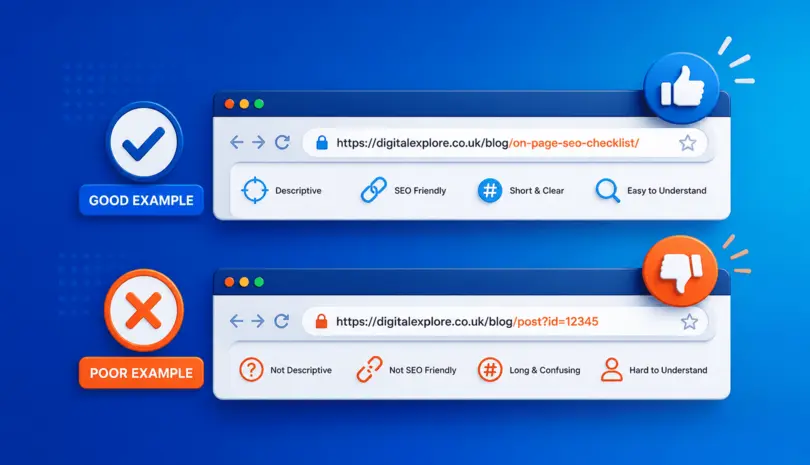
A strong SEO URL should:
- Include the main keyword
- Use lowercase letters
- Use hyphens between words
- Avoid dates unless needed
- Avoid unnecessary numbers or parameters
Keep it clean.
A simple URL is easier to understand, easier to share and better for long-term SEO.
8. Front Load Your Primary Keyword
Your primary keyword should appear early in the content.
Use it naturally in:
- Title tag
- Meta description
- H1
- First 100 words
- One H2 or H3
- Body copy
- Image alt text where relevant
For example:
This on page SEO checklist UK guide explains how to optimise your pages for stronger Google rankings, better user experience and improved visibility in AI Overviews.
That is clear and natural.
Do not repeat the keyword in every paragraph.
Google understands context. Readers hate repetition.
9. Optimise for Featured Snippets
Featured snippets appear above standard organic results and can drive strong visibility.
To optimise for them, answer questions directly.
Use:
- Short definitions
- Numbered lists
- Tables
- Step-by-step instructions
- FAQs
- Clear headings
Example snippet-style answer:
On page SEO is the process of optimising individual web pages to improve search rankings, user experience and search engine understanding. It includes title tags, headings, content quality, internal links, images, schema markup, mobile usability and page speed.
That kind of answer is easy for Google to extract.
Make every important section answer one clear question.
10. Write Comprehensive, Helpful Content
Thin content rarely ranks well in competitive search results.
But long content alone is not the answer.
Your content needs depth, not padding.
A strong on page SEO guide should cover:
- What on page SEO is
- Why it matters
- How to research keywords
- How to match search intent
- How to optimise metadata
- How to structure headings
- How to improve content quality
- How to optimise images
- How to improve page speed
- How to add schema
- How to optimise for AI Overviews
- How to avoid common mistakes
The goal is not to write more words.
The goal is to remove the need for the reader to go elsewhere.
Content Quality and E-E-A-T Checklist
11. Demonstrate Real Experience
Google wants content that shows real understanding.
That means your content should feel like it was written by someone who has actually done the work.
Add:
- Practical examples
- Before and after improvements
- SEO audit insights
- Screenshots where useful
- Real business scenarios
- Lessons from client work
For example:
Instead of saying optimise title tags, show what a weak title looks like and how to improve it.
Weak:
Home
Better:
SEO Agency Birmingham | Digital Marketing Services UK
Experience makes content more useful.
Useful content earns trust.
12. Show Clear Expertise
Expertise is about accuracy, depth and confidence.
You can improve expertise signals by including:
- Clear explanations
- Correct terminology
- Actionable advice
- Author bios
- Relevant credentials
- Updated information
- Links to trusted sources
For Digital Explore, the author bio should mention experience in SEO, PPC, content marketing and digital strategy.
Example author bio:
Written by the Digital Explore team, specialists in SEO, PPC, content marketing and digital growth for UK businesses.
This helps users understand why they should trust the advice.
13. Build Authority With Supporting Content
One blog post can rank, but a topic cluster is stronger.
To build authority around on page SEO, Digital Explore should internally link to related guides such as:
- Technical SEO checklist
- Keyword research guide
- Local SEO guide for UK businesses
- Content marketing strategy
- SEO audit checklist
- Link building guide
- WordPress SEO guide
This shows Google that your website covers the wider topic properly.
Topical authority is not built from one article.
It is built from connected, useful content.
14. Improve Trust Signals
Trust is a ranking and conversion asset.
Your page should make it easy for users to trust your business.
Add trust signals such as:
- Clear contact details
- About page
- Author information
- Client examples
- Case studies
- Privacy policy
- Editorial standards
- Secure HTTPS website
- Updated date
- External links to reliable sources
For YMYL topics such as finance or health, this is critical. For SEO content, it still matters because users are deciding whether your advice is credible.
Trust reduces friction.
And friction kills conversions.
Technical On Page SEO Essentials
15. Improve Page Speed
A slow website creates a poor user experience.
It also makes crawling and conversions harder.
Focus on:
- Compressing images
- Using WebP format
- Reducing unused JavaScript
- Minifying CSS
- Using browser caching
- Improving server response time
- Using a reliable hosting provider
- Loading key content quickly
Core Web Vitals to monitor:
| Metric | What It Measures |
| LCP | How quickly the main content loads |
| INP | How quickly the page responds to user interaction |
| CLS | How stable the page layout is |
Use Google PageSpeed Insights to test your pages.
Do not chase a perfect score for vanity.
Focus on making the page genuinely faster and easier to use.
16. Optimise for Mobile First
Google uses mobile-first indexing, which means the mobile version of your page matters heavily.
Check:
- Text is easy to read
- Buttons are easy to tap
- Menus work properly
- Images scale correctly
- Forms are simple
- Pop-ups do not block content
- Pages load quickly on mobile data
Many UK users search from mobile devices, especially for local services.
If your mobile experience is poor, you are leaving rankings and leads on the table.
17. Optimise Images for SEO
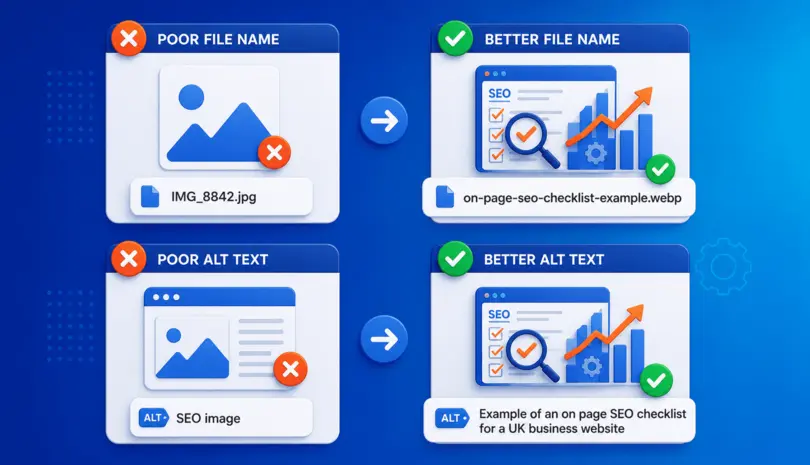
Image SEO helps with accessibility, speed and visibility in image search.
Best practices:
- Use descriptive file names
- Add helpful alt text
- Compress images before uploading
- Use WebP where possible
- Add width and height attributes
- Use lazy loading
- Avoid uploading huge image files
Alt text should describe the image, not stuff keywords.
18. Add Schema Markup
Schema markup helps search engines understand your content more clearly.
For this post, useful schema types include:
- Article schema
- FAQ schema
- Breadcrumb schema
- Organisation schema
- Author schema
- HowTo schema, where appropriate
Schema does not guarantee rich results, but it improves clarity.
For a checklist-style post, FAQ schema can be especially useful because it supports question-based visibility.
Use tools such as:
- Google Rich Results Test
- Schema.org
- Rank Math
- Yoast SEO
- WordPress schema plugins
Keep schema accurate.
Do not mark up content that is not visible on the page.
19. Strengthen Internal Linking
Internal links help users and search engines discover related content.
They also pass authority between pages.
Use internal links to connect this post to:
- SEO services page
- Technical SEO guide
- Local SEO guide
- Keyword research blog
- Content marketing blog
- SEO audit page
- Contact page
Use descriptive anchor text.
Good anchor text:
technical SEO checklist
Poor anchor text:
click here
Internal links should feel useful, not forced.
A strong internal linking structure can help a new blog post rank faster.
20. Link to Trusted External Sources
External links help support claims and build trust.
For this post, link to authoritative sources such as:
- Google Search Central
- Google PageSpeed Insights
- Schema.org
- GOV.UK, where relevant
- Office for National Statistics, where relevant
- Reputable SEO research sources
External links should support the reader.
Do not link to direct competitors unless there is a clear reason.
Use external links to strengthen credibility, not leak attention.
Advanced On Page SEO Checklist for 2026
21. Optimise for AI Overviews
AI Overviews reward content that is clear, well-structured and easy to summarise.
To improve your chances, write sections that answer specific questions directly.
Use:
- Clear definitions
- Short explanatory paragraphs
- Step-by-step lists
- Comparison tables
- FAQ sections
- Entity-rich language
- Consistent terminology
For example, instead of writing a vague paragraph about metadata, create a section titled:
How do title tags help SEO?
Then answer it clearly.
AI systems prefer content that removes ambiguity.
So do users.
22. Use Entity SEO and Topical Clarity
Entity SEO is about helping search engines understand the people, places, brands, concepts and relationships in your content.
For this post, important entities include:
- On page SEO
- Google Search
- Google Search Console
- Core Web Vitals
- Schema markup
- AI Overviews
- E-E-A-T
- UK businesses
- Digital Explore
Use related terms naturally throughout the article.
For example:
Instead of only repeating on page SEO, include related phrases such as:
- content optimisation
- HTML elements
- search intent
- internal linking
- page experience
- technical SEO
- organic rankings
This helps Google understand the topic in greater depth.
23. Keep Content Fresh
Freshness matters, especially for SEO topics.
Search changes quickly.
Update this post regularly with:
- New Google updates
- Current best practices
- New tools
- Updated screenshots
- Changed ranking factors
- Fresh examples
- New FAQs
Add a visible line near the top:
Last updated: May 2026
This tells users the guide is current.
It also helps Google understand that the content is maintained.
Outdated SEO advice can damage trust quickly.
24. Improve User Experience and Engagement
SEO does not stop when someone lands on the page.
If users cannot read, navigate or act on your content easily, performance suffers.
Improve engagement by adding:
- Table of contents
- Short paragraphs
- Clear subheadings
- Helpful examples
- Visuals
- Checklist boxes
- Jump links
- Strong calls to action
- Related resources
Avoid walls of text.
People scan before they read.
Make the page easy to scan, then reward deeper reading with useful detail.
25. Optimise for Conversions
Traffic is useful only if it supports business goals.
Every SEO page should have a conversion path.
For this post, Digital Explore can include CTAs such as:
- Request a free SEO audit
- Download the on page SEO checklist
- Book an SEO consultation
- View our SEO services
- Get help improving your rankings
Place CTAs:
- After the introduction
- Midway through the checklist
- Before the FAQ section
- At the end of the post
Make the CTA relevant to the content.
Example:
Want to know what is holding your website back? Get a free on page SEO audit from Digital Explore.
That is direct and useful.
26. Add Original Examples
Original examples separate your content from generic SEO articles.
Include examples such as:
- Weak title tag vs improved title tag
- Poor URL vs optimised URL
- Bad internal link anchor vs strong anchor
- Thin content vs helpful content
- Missing schema vs correct schema
Example:
Poor title:
Services
Better title:
SEO Services for UK Businesses | Digital Explore
Poor meta description:
We provide SEO services. Contact us today.
Better meta description:
Improve your Google rankings with SEO services for UK businesses. Digital Explore helps you increase organic traffic, leads and search visibility.
Examples make advice easier to apply.
That is what readers remember.
27. Add FAQ Content for People Also Ask
FAQs help target long-tail searches and support AI Overview visibility.
Good FAQs answer real questions clearly.
Place the FAQ section near the end of the post.
Avoid adding random questions just to increase word count.
Use questions your audience actually asks.
28. Include a Table of Contents
A table of contents improves user experience on long-form content.
It helps readers jump to the section they need.
It can also generate sitelinks in search results.
Recommended table of contents:
- What is on page SEO?
- Why on page SEO matters in 2026
- Complete on page SEO checklist
- Content quality and E-E-A-T
- Technical on page SEO
- Advanced SEO for AI Overviews
- Common mistakes
- Best tools
- FAQs
For long guides, this is not optional.
It makes the page easier to use.
29. Add Clear Calls to Action
Do not let readers finish the article with nowhere to go.
End each major section with a logical next step.
Examples:
- Need help finding SEO issues? Request an audit.
- Want better content rankings? Speak to Digital Explore.
- Not sure where to start? Download the checklist.
Keep CTAs simple.
One clear action beats five competing options.
Common On Page SEO Mistakes to Avoid
Even strong websites often lose rankings because of basic on page mistakes.
Here are the ones to watch.
Keyword Stuffing
Repeating the same keyword too many times makes content awkward and low quality.
Use natural language.
Google understands related terms.
Duplicate Title Tags
Every important page should have a unique title tag.
Duplicate titles confuse search engines and reduce relevance.
Weak Meta Descriptions
A bland meta description can reduce clicks.
Even if you rank, users may choose a better-written result.
Poor Search Intent Match
This is one of the biggest SEO problems.
If users want a checklist and you give them a sales page, they will leave.
Thin Content
Thin content does not answer the query properly.
Add examples, explanations, steps and supporting details.
Slow Page Speed
Slow pages frustrate users and reduce conversions.
Compress images, remove bloat and improve hosting where needed.
Poor Mobile Experience
If the mobile version is hard to use, rankings and leads suffer.
Test your page on real devices.
Missing Internal Links
Pages with no internal links are harder for Google to discover and understand.
Link related content together.
No Schema Markup
Schema is not always required, but it helps search engines understand your page.
For blogs, Article and FAQ schema are strong starting points.
Ignoring Updates
SEO content becomes outdated.
Review important pages at least every six months.
Best Tools for On Page SEO in 2026
You do not need dozens of tools.
You need the right ones.
Google Search Console
Use it to track:
- Queries
- Impressions
- Clicks
- Average position
- Indexing issues
- Page performance
This is essential.
Google Analytics 4
Use GA4 to understand:
- User behaviour
- Traffic sources
- Engagement
- Conversions
- Landing page performance
SEO should connect to business results, not just rankings.
PageSpeed Insights
Use it to check:
- Core Web Vitals
- Mobile performance
- Desktop performance
- Speed issues
- Improvement suggestions
Screaming Frog
Useful for technical checks such as:
- Missing title tags
- Duplicate metadata
- Broken links
- Redirect chains
- Missing alt text
- Crawl depth
Ahrefs
Useful for:
- Keyword research
- Competitor analysis
- Backlink analysis
- Content gaps
- Ranking tracking
Semrush
Useful for:
- Keyword research
- SEO audits
- Content optimisation
- Competitor research
- Position tracking
Surfer SEO
Useful for content optimisation, but use it carefully.
Do not write for a score.
Use it to identify gaps, then write for humans.
Rank Math or Yoast SEO
Useful for WordPress websites.
They help with:
- Metadata
- Schema
- Canonicals
- XML sitemaps
- Basic SEO checks
Plugins help, but they do not replace strategy.
Free On Page SEO Checklist Template
Use this checklist before publishing or updating any important page.
| SEO Element | Checked? | Notes |
| Search intent matched | ☐ | |
| Primary keyword selected | ☐ | |
| Secondary keywords included | ☐ | |
| Title tag optimised | ☐ | |
| Meta description written | ☐ | |
| One clear H1 used | ☐ | |
| H2s and H3s structured properly | ☐ | |
| URL is clean and readable | ☐ | |
| Keyword included naturally in intro | ☐ | |
| Content answers the query fully | ☐ | |
| Internal links added | ☐ | |
| External trusted sources linked | ☐ | |
| Images compressed | ☐ | |
| Alt text added | ☐ | |
| Schema markup added | ☐ | |
| Mobile experience tested | ☐ | |
| Page speed checked | ☐ | |
| CTA added | ☐ | |
| FAQ section included | ☐ | |
| Content reviewed for accuracy | ☐ | |
| Last updated date added | ☐ |
Final Thoughts
On page SEO is not just a checklist of technical tasks.
It is the foundation of how your website communicates with Google and with your audience.
A strong page should be easy to understand, easy to use and genuinely helpful. It should answer the search query clearly, support the user’s next step and give search engines enough context to trust it.
For UK businesses in 2026, the opportunity is clear.
Most websites still have weak titles, thin content, poor internal links, slow pages, vague headings and no real AI Overview strategy.
Fix those basics properly and you are already ahead of many competitors.
Then go further.
Add original examples. Build topical authority. Improve trust signals. Keep your content updated. Make every page useful enough that users do not need to return to Google for a better answer.
That is how on page SEO works now.
Not tricks.
Not shortcuts.
Just clear, useful, well-structured pages that deserve to rank.
FAQs
The most important part of on page SEO is matching search intent. If your page does not give users what they came for, other optimisation work will have limited impact. Once intent is correct, focus on content quality, title tags, headings, internal links, page speed and trust signals.
Review important pages every three to six months. For competitive topics, check them more often. Update pages when rankings drop, search intent changes, competitors improve their content or Google releases major updates.
On page SEO can help you rank, especially for low to medium competition keywords. For competitive UK search results, you usually need strong content, technical SEO, internal linking, backlinks, topical authority and a trusted brand presence.
AI Overviews make clear, structured and trustworthy content more important. Pages that answer questions directly, use logical headings and explain topics well are more likely to be understood and cited by AI-powered search features.
Useful on page SEO tools include Google Search Console, PageSpeed Insights, Screaming Frog, Ahrefs, Semrush, Surfer SEO, Rank Math and Yoast SEO. The best tool depends on whether you are checking keywords, technical issues, content gaps or page performance.
An SEO blog post should be as long as needed to answer the search query properly. For a competitive topic like on page SEO checklist, a detailed guide of 3,000 to 5,000 words may be appropriate. Quality matters more than word count.
On page SEO focuses on individual page elements such as content, headings, title tags, internal links and images. Technical SEO focuses on site-wide crawlability, indexing, site speed, architecture, structured data and technical performance. The two often overlap.
Keyword density is not a useful target. It is better to use your primary keyword naturally and include related terms that help explain the topic. Forced repetition can harm readability and make the page feel low quality.
Not every page needs schema, but important pages should use relevant structured data. Blog posts can use Article schema, FAQ pages can use FAQ schema, and service pages can use Organisation, LocalBusiness or Service schema where appropriate.
Yes. Strong on page SEO improves clarity, structure, trust and user experience. This can help users understand your offer faster and take action, which improves enquiries, leads and sales.
Ready to Improve Your On Page SEO?
If your website is not ranking where it should, the issue may not be your entire SEO strategy.
It might be the pages themselves.
Digital Explore helps UK businesses improve on page SEO, content quality, technical performance and organic visibility.
Request an SEO audit today and find out what is holding your website back.
