

What Is Primary Keyword and Why It Matters
If you’re learning SEO or trying to write content that shows up on Google, you’ve probably heard the phrase “primary keywords” before. But what are they really?
Primary keywords are the main keywords or main search terms that tell Google, “Hey! This page is about this topic.” They’re the central theme. Everything else you write connects to that one big idea. That’s how primary keywords work in SEO.
Why Do Primary Keywords Matter?
When someone searches something on Google, the search engine checks your page to see if it matches what the person wants. If your page uses a clear and strong primary keyword, Google understands what you’re writing about. That means your page has a better chance of showing up when people search for that term.
So if you’re writing about “vegan recipes,” you want that exact phrase to appear in the right places. This shows search engines your page is a good match.
What Makes a Good Primary Keyword?
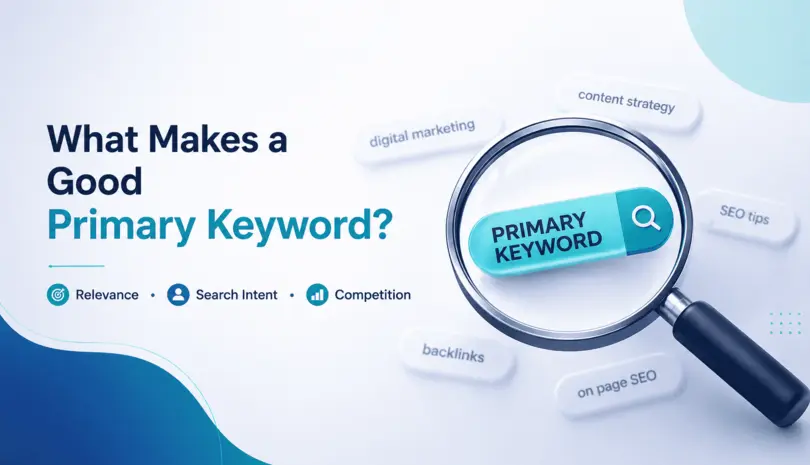
Not every keyword is a winner. Here’s how to pick the best primary keyword in SEO:
1. Search Volume
This shows how many times people search for that keyword each month. Bigger volume = bigger chance to get traffic. But also, high volume can mean more competition. So don’t just go for the biggest number.
2. Keyword Difficulty (KD)
This tells you how hard it is to rank for the keyword. High difficulty means other strong websites already rank for it. If your site is new, aim for keywords with low to medium difficulty.
3. Relevance to Your Audience
Is the keyword really what your visitors want to read about? If not, skip it. A keyword might be popular, but if it doesn’t match your message or what your brand does, it won’t help you.
4. Search Intent
This is super important. What does the person want when they search that keyword?
- Do they want to learn something? (Informational)
- Are they looking for a brand or tool? (Navigational)
- Are they comparing things to buy? (Commercial)
- Are they ready to buy or take action? (Transactional)
Pick a primary keyword that matches the kind of page you’re writing. If it’s a blog post, go for informational. If it’s a product page, go for transactional.
How to Use and Optimize Your Main Keyword (Without Overdoing It)
Understanding how to place and use your primary keyword can improve your search rankings and help more people find your content. Here’s how to do it properly, even if you’re just getting started.
Include the Keyword in Your Page Title
Your title tag is the name of your page that shows up in search results and on the browser tab. Put your main keyword near the beginning of this title. It tells both people and search engines what the page is about right away.
Keep your title short, clear, and focused on the topic.
Example: Instead of “10 Tips for Writing,” use “10 SEO Writing Tips to Boost Rankings.”
Use the Keyword in the URL (Slug)
The URL is the website link. You should add your main keyword to the part of the URL that comes after the slash, this is called the slug.
Example:
It helps readers and search engines understand your topic at a glance.
Add the Keyword Early in the Content
Try to include your main keyword within the first 100 words of your page or article. This gives readers and search engines a quick idea of what the page is about. Don’t force it, make sure it fits into the sentence naturally. Rewrite it if it sounds odd.
Tip: You’re setting the stage. Make it clear what the content is about right away.
Place the Keyword in the H1 Heading
Your H1 heading is usually the largest and most important heading on the page. This is the headline that shows up at the top of your article. Include your keyword once in the H1 to signal the topic clearly. One time is enough so avoid repeating it too often.
Use the Keyword in Subheadings (H2 or H3)
Subheadings break your content into sections and make it easier to read. Use your keyword in one or two subheadings where it fits naturally. If the exact keyword doesn’t make sense, try a variation or a related phrase. Subheadings should still make sense to readers.
Add the Keyword to Image Alt Text
Each image on your page should have alt text, which is a description for people who can’t see the image and for search engines. If your keyword fits the image, use it in the alt text. Keep it short and descriptive.
Example:
Use the Keyword in the Meta Title and Description
Your meta title and meta description appear on Google when someone searches for your page. This is your first chance to attract a click.
- Keep the meta title under 60 characters
- Keep the meta description under 160 characters
- Use your keyword in both, but naturally
- Add a reason for the reader to click, like a benefit or a solution
Avoid Repeating the Keyword Too Often
Using your keyword too many times on the same page is called keyword stuffing. Google doesn’t like this, and neither do your readers. Use your main keyword a few times, but mix in related phrases and synonyms. This keeps your writing smooth and more interesting.
Make Sure Your Content Matches Search Intent
Search intent means what someone is really looking for when they type something into Google. If the keyword is “how to tie a tie,” they want clear steps, not fashion history. Match your content to the user’s goal. That’s what makes your page useful, and that’s what Google rewards.
Focus on Clarity and Natural Language
Read your content out loud. Does it sound natural? Or does it sound like a robot? Make sure your keyword fits like a regular part of the sentence. If not, rewrite the sentence. You want your content to be clear, human, and easy to follow.
Common Mistakes to Avoid
Here’s what you need to avoid.
- Choosing too broad of a keyword: Harder to rank and harder to match the topic well.
- Using multiple primary keywords on one page: Confuses Google.
- Skipping keyword research altogether: You might target something nobody is searching for.
Writing first, then picking a keyword: Your keyword should guide your content, not the other way around.
Final Thoughts
Picking and using the right primary keywords is one of the smartest things you can do for SEO. It helps your content get noticed, rank better, and reach the people searching for exactly what you offer.
Remember: your main keyword is like the signpost of your page. Use it well, guide your content with it, and keep everything natural and helpful. That’s how search engines and people will find you.
Ready to take your content strategy to the next level?
At DigitalExplore, we help brands unlock real growth through smart SEO and user-focused strategies. Whether you’re just starting out or looking to refine your keyword game, we’ve got the tools and insights to help you succeed.
Start exploring smarter SEO with DigitalExplore, where content meets clarity.
FAQs
Primary keywords are the main words your page is focused on. Secondary keywords support the main topic and help cover related ideas.
Yes! A good page often ranks for dozens, even hundreds of related keywords, not just the main one.
No. Primary keywords can be short or long. It depends on the topic and what your audience is searching for.
You can target one or two very close variations, like “digital marketing strategy” and “digital marketing strategies.” But don’t target two totally different ones on the same page.
