

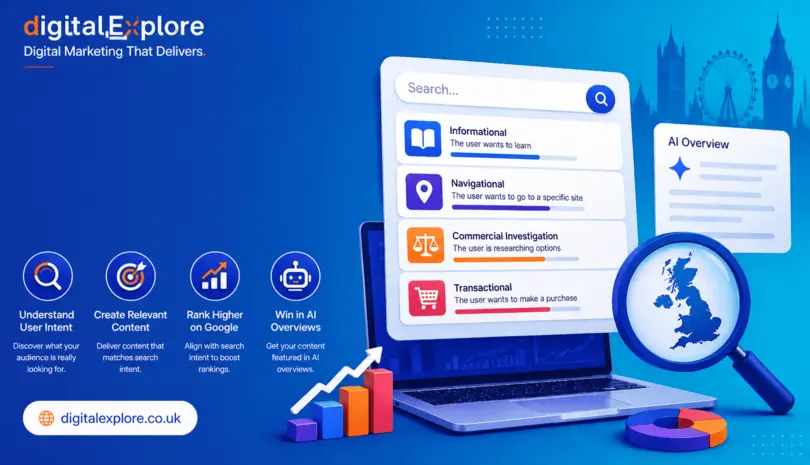
What Is Search Intent? How UK Businesses Can Rank Higher on Google and AI Overviews
Most businesses still treat SEO like a keyword game.
They find a phrase with decent search volume, write a page around it, add the keyword a few times, and hope Google rewards them.
That approach is outdated.
Here’s the thing. Google no longer ranks pages just because they mention the right words. It ranks pages that best satisfy the reason behind the search.
That reason is search intent.
If someone searches for the best running shoes for flat feet, they do not want a product category page filled with generic trainers. They want comparisons, reviews, recommendations, and buying guidance.
If your page misses that, you lose.
And now with Google AI Overviews changing how information is surfaced, matching search intent matters even more. Google is increasingly looking for content that directly answers users, solves problems quickly, and demonstrates genuine relevance.
For UK businesses, this creates both a challenge and an opportunity.
Get search intent right, and you can rank higher, earn better traffic, increase conversions, and become a trusted source in AI generated search results.
Get it wrong, and even strong websites can disappear beneath competitors.
Let’s break it down properly.
What Is Search Intent?
Search intent is the purpose behind a user’s search query.
In simple terms, it answers one question:
Why did this person search for this?
Every search has an underlying goal. People are either looking to learn something, find something specific, compare options, or buy.
For example:
- What is SEO = informational
- BBC iPlayer login = navigational
- Best broadband deals UK = commercial investigation
- Buy office chairs London = transactional
This matters because Google’s entire job is to give users the most useful result for that purpose.
So while keywords still matter, intent matters more.
Keywords tell Google what the query says
Search intent tells Google what the user actually wants
That difference changes everything.
Why Search Intent Matters More Than Ever in 2026
Google has become far more sophisticated.
Its systems now analyse user behaviour, content quality, context, and satisfaction signals.
That includes:
- Click through rate
- Bounce rate
- Dwell time
- SERP engagement
- Query reformulation
What this really means is simple.
If users click your page and immediately leave because it does not solve their problem, Google notices.
Search intent directly affects:
Rankings
Pages that align with intent perform better.
Conversions
Relevant visitors are more likely to act.
AI Overview visibility
Google’s AI prefers concise, accurate, intent matched content.
Authority
Useful pages earn links, mentions, and trust.
This is why many businesses struggle. They optimise for traffic, not relevance.
The 4 Core Types of Search Intent
Understanding the four main categories gives you a practical SEO advantage.
1. Informational Intent
The user wants knowledge.
Examples:
- What is local SEO
- How does PPC work
- Symptoms of flu
Best content format:
- Blog posts
- Guides
- Tutorials
- Explainers
Goal: Educate clearly.
2. Navigational Intent
The user wants a specific site or page.
Examples:
- HMRC login
- Facebook Ads Manager
- Ahrefs blog
Best content format:
- Homepage
- Login page
- Brand page
Goal: Make access easy.
3. Commercial Investigation
The user is researching before buying.
Examples:
- Best CRM software UK
- Shopify vs WooCommerce
- Top SEO agencies London
Best content format:
- Comparison articles
- Reviews
- Roundups
Goal: Build trust and guide decisions.
4. Transactional Intent
The user is ready to act.
Examples:
- Hire SEO consultant Manchester
- Buy standing desk UK
- Book boiler repair near me
Best content format:
- Service pages
- Product pages
- Landing pages
Goal: Convert
How Google Detects Search Intent
Google does not just read keywords. It analyses patterns.
Here’s what it looks at:
Query language
Words like buy, best, how, near me, or review
SERP structure
If Google shows product pages, users likely want to buy
If it shows guides, users likely want information
Historical behaviour
What users typically click for similar searches
Entity relationships
Google understands context beyond exact phrases
Location
A UK user searching football boots may see different results than a US user
This is why blindly targeting keywords without checking search results is risky.
How to Identify Search Intent Before Creating Content
Before writing anything, study the search results.
Step 1: Google the keyword
Look at the top 10 pages
Step 2: Analyse page types
Are they blogs, service pages, videos, product pages?
Step 3: Check People Also Ask
These reveal related user concerns
Step 4: Review featured snippets and AI Overviews
Google is literally showing you preferred formats
Step 5: Match content to funnel stage
Awareness, consideration, or decision
This process alone can save months of wasted SEO effort.
How UK Businesses Can Optimise for Search Intent
Let’s make this practical.
If you run a UK business, intent should shape your entire content strategy.
For local businesses:
Use location + service intent
Example: emergency plumber Birmingham
For ecommerce:
Create category pages for buying keywords
Create guides for comparison keywords
For service providers:
Build trust focused pages around commercial investigation
For publishers:
Target informational queries with topical authority
The smartest strategy is not one page per keyword.
It is one ecosystem per customer journey.
How to Rank in Google AI Overviews
This is where most businesses are behind.
AI Overviews pull from content that is:
Clear
Direct answers near the top
Structured
Logical headings and subheadings
Credible
Expertise, authority, trust
Comprehensive
Covers follow up questions
Entity rich
Includes recognised concepts and context
To improve your chances:
- Answer questions immediately
- Use FAQ sections
- Add schema markup
- Build topical clusters
- Include UK specific relevance
- Keep content factual and readable
Think less about keyword repetition and more about answer precision.
Common Search Intent Mistakes
Here’s where rankings often collapse.
Mistake 1:
Writing blog posts for buy now keywords
Mistake 2:
Creating sales pages for informational searches
Mistake 3:
Ignoring SERP signals
Mistake 4:
Over targeting broad terms
Mistake 5:
Forgetting local modifiers
The fix is usually simple: Match format to intent.
Real Example
Keyword:
Best accounting software UK
Wrong page: A homepage selling one software product
Right page: A comparison guide reviewing multiple platforms, pricing, pros, cons, and recommendations
Why?
Because users are comparing, not buying immediately.
Best Tools for Search Intent Research
Google Search
Still the best free tool
Google Search Console
Shows actual query patterns
Ahrefs
SERP overview and keyword intent
Semrush
Intent labels and competitor analysis
AlsoAsked
Excellent for content gaps
The Future of Search Intent
Search is moving beyond typed keywords.
Voice search, AI assistants, predictive recommendations, and conversational interfaces are changing how people search.
What this really means is businesses must optimise for:
- Questions
- Context
- Conversation
- Topical authority
Search intent is no longer an SEO tactic.
It is the foundation of digital visibility.
Final Thoughts
If you want better rankings in Google UK and stronger presence in AI Overviews, search intent is not optional.
It is the strategy behind modern SEO success.
Stop asking:
Which keyword should I target?
Start asking:
What does this user actually need?
That shift changes your content, your traffic quality, and your results.
Because the businesses that win search are not the ones stuffing keywords.
They are the ones solving intent better than anyone else.
FAQs
Search intent is the reason behind a user’s query, whether they want information, navigation, comparison, or purchase.
Because Google ranks pages based on how well they satisfy user needs, not just keyword relevance.
Informational, navigational, commercial investigation, and transactional.
Analyse Google’s top results, SERP features, query wording, and content types.
Yes. AI Overviews prioritise relevant, structured, trustworthy answers.
In many cases, yes. Keywords matter, but intent determines whether your content actually ranks.
Absolutely. Precise intent alignment often beats larger competitors with weaker relevance.
Lower rankings, higher bounce rates, and reduced conversions.
